
Es ist etwas leerer geworden im Raum Panel 1, als Thomas Knüwer die Moderation startete. Die hochkarätig besetzte Runde – Geraldine Wilson (Yahoo!), Matt Cohler (Google) und Mike Jennigs (Facebook). – sollte die Frage klären: What Real-time really means.
Der Markt für mobile Internetanwendungen ist sicher einer der spannendsten unserer Zeit, darin waren sich alle einig. Zwar ist das Wachstum enorm, aber die Nutzung ist lange noch nicht Mainstream. Drei Jahre werde das noch dauern, schätzte Matt Cohler von Google.
Und so ging es vor allem um die Zukunft, und wie die großen drei – Facebook, Google und Yahoo! – sie zu gestalten gedenken. Während Google sich mit seinem Betriebssystem Android in der für Google üblichen Metaebene positioniert, will Geraldine Wilson Yahoo! im Online-Werbemarkt über Search-Advertising zur Marktführerschaft bringen. Also ausgerechnet das Feld, das Google im klassischen Internet marktbeherrschendend besetzt hat. Mike Jennigs will Facebook auf das Handy bringen. Soziale Netzwerke sollen auch im mobilen Bereich vor allem über Advertising monetarisiert werden.
Auf Thomas Knüwers Frage, ob sich die Leute denn gerne solche Ads anschauen würden, behauptete Jennings, dass er sich immer gerne auf ihn zugeschnittene Werbung anschaut. Matt Cohler bringt das Beispiel der ortsbezogenen Werbung auf der mobilen Maps-Suche.
Die Gute Nachricht: Android soll in der zweiten Hälfte 2008 endlich released werden. Eines ist sicher: wenn das kostenlose Handybetriebssystem auf den Markt kommt, können sich Wettbewerber wie Symbian aber auch das iPhone warm anziehen.
Angesichts der geplatzten Übernahme von Yahoo! durch Microsoft, fragt Knüwer Geraldine Wilson, ob es derzeit schwer sei, sich auf das normale Geschäft zu konzentrieren. Wilson streitet das natürlich ab: Man konzentriere sich ausschließlich auf die hochgesteckten Ziele. Thomas Knüwer schaut skeptisch.
Angst vor der Zukunft hat aber keiner hier, das beteuern alle. Man habe die richtigen Strategien für den unberechenbaren Markt der mobilen Internetnutzung. Really?
Mai 2008
Steve Rubel vs Stowe Boyd
My favorite Panel of the day, expectation-wise: Stowe Boyd meets Steve Rubel. This should be good. So let’s dive right in:
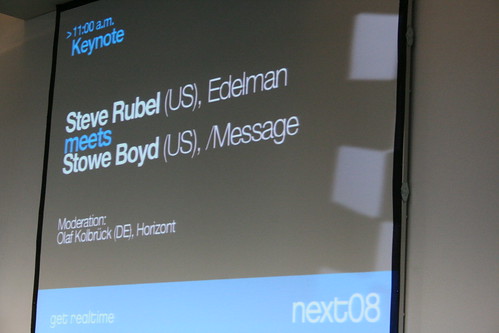
Steve Rubel quotes Groundswell & insists that all of us in the industry have, to some degree, tunnel vision: We think that everybody is active in the social media sphere, blogging, twittering, using RSS. However, only 13% (says Rubel) are „Creators“, i.e. actively produce content on the web. The rest are rather consumers. A quick check with the audience shows: Even here at next08, only about 15-20% are on Twitter. This surprises me – my Twitter client is going crazy with next08 news.
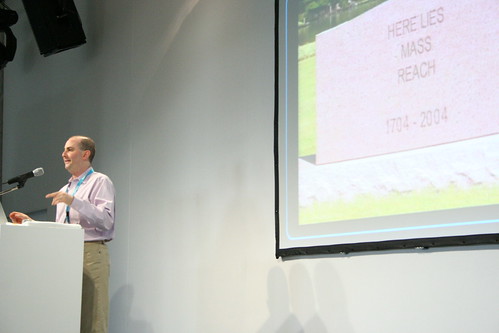
So what does that mean? It’s still to complicated to really put stuff on the web. However, providing easier ways to publish, or even to re-publish information is key. Make it simple to re-publish your stuff! Widgets are one way to go, simple embed codes are another. Of course there’s many others, too.
Rubel speaks of faint signals that pose challenges. Attention crash is a major one: We can’t really keep up with the hundreds of emails. (I imagine Stowe Boyd has a thing or two to say about this.) Digital curators who pre-filter information can help fight information. While it’s a great term, this idea seems a bit oldschool, at least in the sense that curators could be replaced by collaborative filters. Talking of collaboration, this is another trend Rubel sees: The internet has been, is, and will be used in more and more collaborative ways. Think pledgebank. Rubel points out one problem of online collaboration, though; When our info lives in the cloud, be prepared for data leak. We’re talking about technological solutions, which are never perfect. At some point, some of your data will leak.
Some good points there – let’s see what Stowe Boyd replies.
Enter Stowe Boyd„>Stowe Boyd, author of /Message, with an apology: Years of blogging, he says, have transformed him and his presentation style. In order to follow his presentation, we’ll all have to transform as well, we need to become active participants. (Now isn’t that a neat trick to kick off your presentation? Heh.) But Boyd makes his point: The web has changed tremendously from the solitary, a-social web 1.0 to the inherently very social web 2.0 world.
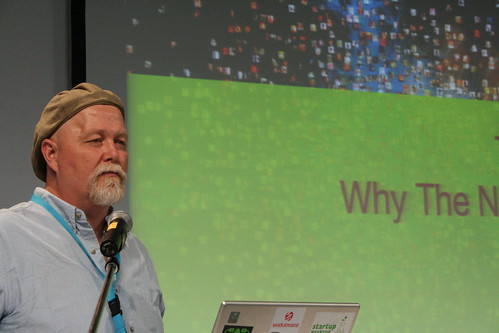
Memorable slide: „Social = Me First“. That’s not to say, Boyd stresses, that folks out there are selfish. But everybody is naturally to some degree self-centered, people define themselves through relationships with other people. „And that’s good!“
„The Web is no democracy, but it’s not a hierarchy.“ Boyd keeps slinging out these slides that are just so sticky. The web has tribal characteristics: Friendships & relationships change – whether you call it „continuous partial friendships“ (D. Weinberger) or „niche friendships“ (Boyd), some friends we only bond with over very specialized, fractured, long tail-ish relationships. This ties right into Boyd’s next point, which is also one of his favorite topics: The Web of Flow (as opposed to email). Tools like Twitter, lifestreaming, workstreamer, friendfeed, just to name a few, they work very different from the old point-to-point, a-synchronous way of communication. Good example: His kids simply refuse to use voicemail – it’s too slow, too time-intense, doesn’t tie into their daily life flow. „If it’s important, it’ll resurface“, they think. Good point, eh?
Good stuff – keep an eye on Stowe Boyd’s vendetta against email and pro flow tools!
next08-Event-Blogger: Michael Seemann
Hallo, Michael Seemann mein Name.
Als eigentlicher Promotionsstudent versuche ich eine Dissertation zu schreiben, die sich auf kulturwissenschaftliche Art und Weise den Neuen Medien widmet. Dementsprechend versuche ich als Blogger meine Posts hier und da mit Theoriefragmenten zu garnieren, sofern möglich.
Ansonsten: derzeit in Hamburg ansässig. Nebenberuflicher Web-Developer und jetzt, klar: Blogger.
Als nächstes wird man von mir über das Panel: What Real-Time really Means erfahren.
next08-Event-Blogger: Peter Bihr
Blogging live from Panel 2, where Michael Jennings‘ presentation about Google’s hot mobile platform Android is being shown on the web. (The real workshops here start at 11:00. First up: „simplifying Analytics for Marketeers“.)
 A few words by the way of introduction: My name is Peter Bihr. When I’m not liveblogging from a conference, I consult on social media strategies. In other words, I work for the Internets. Today we blog on www.fischmarkt.de and next08.com. My regular blog homes are TheWavingCat.com and Blogpiloten.de. Let’s also connect via Twitter.
If you’re around, make sure to say hi. But for now, the most important thing is: Enjoy the conference!
Geraldine Wilson on Yahoo!’s Mobile Strategy
Geraldine Wilson, Yahoo! Mobile Strategist kicked off the content stream of next08. Yahoo! believes that within the next 10 years more people will access the web via a mobile device than by desktop computers. And thats why Yahoo! puts quite some effort into developing mobile applications, is teaming up with other players in the field to offe advertisers a growing mobile audience. Wilson predicts the quite obvious (at least to Yahoo!) when she stated that mobile devices will be the most important advertising channel in the near future.
She argued that the obstacles of creating meaningful mobile user experiences are about to disappear as flatrate pricing allows users to afford the always-on state of using the Internet. To Yahoo! mobile devices are becoming the key means of reaching users in almost any aspects of their life. As connection speeds keep increasing and usable devices are thrown on the market (Think iPhone!) that make using the Internet on the go as easy as carrying a newspaper, the future of advertising lies in the mobile worlds: Anyplace, Anytime and Always-on. It is all about the „A’s“ – did I mention Advertisements?…
Yahoo!’s current and future mobile strategy follows 5 key principles:
- Reach: Building reach is key to Yahoo!s strategy and they are teaming up with partners because they believe that it is not going to be one single player who will rule the mobile market! I asked myself: What about Google?
- Targeting: Targeting individual users with costumized and individualized content and advertisement is pretty much a commonplace here.
- Formats: The standardization of ad-formats and the development of new formats is another area Yahoo! is working on. I asked myself how creative do you have to be to annoy users, and how creative do you have to be to really serve the user meaningful things? No real answer here!
- ROI Yahoo!’s research and marketing guys are constantly working on case studies to measure the success of the company’s effort on the mobile market which directly relates to the last key principle…
- Metrics: Advertisers want numbers! One number is 40%! According to Wilson 40% of the targeted audience for the new Renault Twingo responded to the campaign via mobile. But what does that mean? Is it hard facts ot just flipping around with numbers?
Bottom line: The future (of advertisement) is mobile! …at least according to Yahoo! What do you think? Where is the mobile Internet and mobile ad-selling within in next 10 years?