A day in the life of Mike Arrington

The plane got back to SFO, and a tired Michael Arrington disembarked. Cheap airfare was a real enablr for Arrington’s business. He could go and hang out with startups, and meet some really nice chicks in the Airset.

He got in to the car and flickred the radio on and tuned it to the last.fm station on the dial. It was ideal radiotime. Sometimes the music really can fluctu8 too much, but this wasn’t the usual grat.uito.us crap you find on FM radio which pushes people to buy and iPod and turn it upto11.

As he was driving, he pulled over to the McDonalds drive-thru and decided to order a cheese burger. He pulled up and winded his window down.

"Simpy, Chuquet blurb rrove! Get me a wobblog you qype!"

The voice hesitated and then responded.

"I’m sorry, sir, we are out of that."

"I’ll have McNuggets instead. And bring it here fastr than last time, or I’ll beat your ookles in you dimewise sxip!"

Back on the road, he tucked in. "These are del.icio.us!" he thought to himself. Usually they’re foul, but something must have kept his ikarma levels up. He’d stuck to the 9rules he’d learnt from Mozes.

At the end of the day, even if he spends all of his time climbing the blogladder and hanging out with people with lifetypes, at the end of the day he sits back and enjoys a crazyegg, a quick beer and a hackoff to pics of Lulu. He’s only human after all. Tom Morris

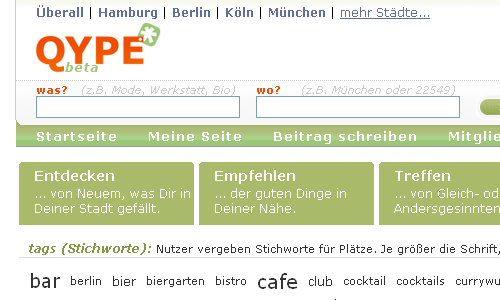
Was man so alles findet, wenn man mal nach Qype sucht.
The Derby

derby.png
Spreadshirt gehörte neulich zu den vier Namen, die mir zum Thema Web 2.0 in Deutschland spontan einfielen. Das war an dem Tag, als mir Andreas Milles ein paar Screens vom jüngsten Spross des Hauses zeigte. Er nennt sich schlicht The Derby und ist jetzt live, wie der Chef gestern vermeldete.

The Derby ist ein Designwettbewerb für T-Shirts (was sonst?). Designer reichen ihre Entwürfe ein, bewerten und kommentieren die Entwürfe anderer, bis in jeder Woche ein Sieger ausgerufen und mit 500 Euro belohnt wird, dessen Shirt in einer begrenzten Auflage gedruckt und verkauft wird.

Wie Lukasz kokett anmerkt, ist das Konzept von Threadless entliehen und findet sich ähnlich auch bei La Fraise in Frankreich. In Deutschland sieht er Cyroline als einen early player auf diesem Feld.

So how spreadshirt will be different as a late mover?

One thing is a differnt regional focus which will be on europe.

One other is, that we think we can execute well (see the threadless founders opinion about copycats at a recent entry at exciting commerce).

And last but most important the derby concept will have some interesting aspects that can not be found with the already existing players. This is not too visble yet at the first basic version of the derby, but stay tuned…

Viel Spaß beim Derby! (Ach ja, Blog ist natürlich Pflicht. Nur den RSS-Feed habe ich noch nicht gefunden.)

Media 2.0: Wo sind die Profite?

murdoch.png
Scott Karp schreibt in Publishing 2.0 unablässig spannende Dinge über The Business of Publishing in the Digital Age (so die Unterzeile). So jüngst eine konzise Abhandlung über die Frage, wie profitabel Media 2.0 tatsächlich ist. Scott macht die Rechnung am Beispiel von MySpace auf, das mit 28 Mrd. Seitenabrufen im März 2006 (was 366 Mrd. auf Jahresbasis ergeben würde) nach Schätzungen auf gerade mal 200 Millionen Dollar Jahresumsatz kommt:

Do the math — that’s a CPM of $0.06 $0.55!

Nun versucht zwar MySpace auf allerlei mehr oder weniger innovative Art, zusätzlichen Werbeplatz zu verkaufen – doch wozu brauchen große Marken eigentlich Werbung auf MySpace, wenn sie genauso gut oder eher noch besser die MySpace-Community nützen können, ohne dort selbst präsent zu sein? Dann nämlich, wenn ihr Branded Entertainment (siehe Pirellifilm, auch wenn das sicher kein übermäßig brilliantes Beispiel ist) seinen Zweck erfüllt und auf MySpace von den Nutzern selbst verbreitet wird?

Es könnte also sein, meint Scott, dass die Effizienzgewinne des Marketing 2.0 zum größten Teil direkt an die Werbungtreibenden gehen – und nicht an die Medien:

I’m speculating that in a 2.0 future, total spending on marketing and advertising will shrink as marketing 2.0 proves to be far more cost efficient than marketing 1.0 — and big advertisers start pocketing that half of their advertising costs that were previously wasted.

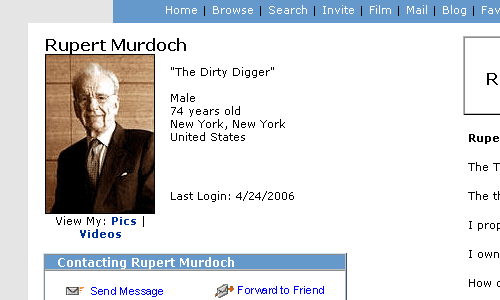
Schlechte Nachrichten für Rupert Murdoch und Georg von Holtzbrinck?