Dennis Crowley: Vergesst Facebook!

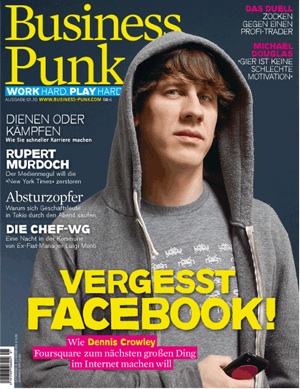
businesspunk.jpgDas ist doch mal eine Ansage. Der Gründer und Kopf von Foursquare ist der Cover-Boy der jüngsten Ausgabe von Business Punk.
Und einer der Top Acts auf der next10, die am 11. und 12. Mai erstmals in Berlin stattfindet. Dort wird Dennis Crowley über die App Economy sprechen, zu deren Protagonisten er gehört.
„Die Über-Facebook-Twitter-Killer-App“, lautet die Überschrift im Heftinnern. Die Geschichte erinnert an die Stories, die bis vor zehn Jahren in ähnlichen Blättern erschienen. Damals in der New Economy. Allerdings mit anderen Akteuren.

Dennis Crowley ist der neue Liebling der US-Internetinvestoren. Sein Ortungsdienst Foursquare könnte das nächste große Ding im Netz werden. Crowley hat nur ein Problem: Seine Gegner heißen Google, Facebook und Twitter.

Is the Majority of Internet Usage Already Mobile or Not?

A majority of the world’s 4.6 billion mobile subscribers uses mobile as their first and only Internet connection, said Nokia CEO Olli-Pekka Kallasvuo at CES last week. The rate of people signing up to use the internet on their handset, he added, is rapidly increasing, possibly at the expense of computer-based browsing.
But does this really mean that the majority of internet services are already accessed on mobile phones globally, not from PCs, as Tomi Ahonen seems to believe? I’m not convinced, since the former (what Nokia said) doesn’t necessarily imply the latter (what Ahonen concludes).
I agree though with Ahonen that it is inevitable that soon the majority of internet access will be from mobile phones. Gartner predicts this threshold to be crossed by 2013. Ahonen notes:

In many Emerging World countries form Bangladesh to South Africa the ratio is more than 4 to 1 and as much as 10 to 1 where more mobile users access internet services (including WAP services) on their phones than on PCs. Even many advanced countries like Japan and Taiwan report the same milestone having passed.

Ahonen sees the mobile and the fixed Internet as different as TV is from radio.

And yes, the ‚mobile internet‘ as the 7th mass medium, is indeed the TV in that analogy, and the old-fashioned ‚legacy‘ internet on PCs, what you may call the ‚real internet‘ as the 6th mass medium is not only different, but it is the lesser opportunity, like radio is to TV. This view, originally seen as very much heresy, is now accepted ever more widely, so you may want to read why the mobile internet is not only different, but economically far more lucrative than the ‚real‘ internet.

Sieben Prognosen für 2010

Wie vor einem Jahr versuche ich mich auch heute mit einer Reihe fundierter Vermutungen, das noch recht neue Jahr 2010 betreffend.

  1. 2010 wird das Jahr der digitalen Revolution. Die Internet-Generation ist reif für den Wandel, wird zum Game Changer und schickt die Babyboomer auf ihr Altenteil.
  2. Die Babyboomer und andere Verlierer der Revolution werden sich heftig wehren und weiterhin versuchen, das Internet zurück in die Verpackung zu stopfen. Doch die Konterrevolution bleibt aus.
  3. Die Netzkritik wird hingegen eines der großen Themen des Jahres. Babyboomer Frank Schirrmacher war nur das Präludium. Inzwischen schicken sich bereits die Revolutionäre von gestern an, in den Chor der Kritiker einzustimmen.
  4. Neben der Maschinenstürmerei 2.0 wird das Ende der Privatsphäre und die Neudefinition der Öffentlichkeit zum zweiten (und wichtigeren) großen Debattenthema.
  5. Der Werbemarkt wird auch im Jahr 2010 stagnieren. Marken und Unternehmen verschieben ihre Budgets weiter in Richtung Internet. Nur ein Teil davon fließt in Onlinewerbung und bleibt so dem Werbemarkt erhalten. Ein immer größerer Anteil wird in Plattformen und Applikationen investiert.
  6. Mobile, ortsbezogene Dienste kommen ganz groß raus. Foursquare wird das neue Twitter (gut, eventuell auch Gowalla). Google wird die lokale, mobile Werbung revolutionieren.
  7. 2010 wird das Jahr der erweiterten Realität. Wir werden eine Reihe spektakulärer Anwendungen auf mobilen Geräten sehen.

Und eine Bonus-Prognose: 2010 wird das Jahr, in dem Print digital wird. Kindle und Nook, iTablet oder iSlate (oder wie auch immer Apple das neue Spielzeug nennen wird) transformieren Nutzererlebnis und Geschäftsmodell des Gedruckten ins Digitale. Binnen fünf Jahren werden die Folgen ähnlich gravierend sein wie iPod und iTunes für die Musikindustrie waren. Behalten Sie auch innovative Formate wie das Miki im Auge.

Was meinen Sie? Welche Themen bestimmen das Jahr 2010?

Reblog this post [with Zemanta]

Jack Dorsey Tries to Change the Credit Card Game

As of today, processing credit cards is just for businesses. And they typically need a certain size to get things started. Well-known Twitter founder Jack Dorsey now tries to change that game with his new start-up Square.
Square allows practically anyone to start accepting payment cards more or less immediately without contracts, monthly fees, or hidden costs. At least that’s the promise. They developed a small, simple dongle that fits into an audio input jack on mobile devices and reads payment cards. This dongle then sends the data to an application that runs on the phone and takes care of the rest.
As a payer, you get your receipts sent to your email or mobile phone instantly and access them securely online. You can also use a text message to authorize every payment in real-time. On the iPhone, the Square app can show a picture of the card holder to the person processing the payment, thus increasing security and decreasing the risk of fraud.
TechCrunch has a short video with Jack Dorsey talking about Square and MG Siegler buying him coffee with his credit card and Square. The first public demo of Square will take place next week at LeWeb.

If you are not convinced, read Om Malik’s excellent piece on why Square exists and who should be worried:

I think that this is truly disruptive. The reason Square exists is because of three macro trends: the pervasiveness of the mobile Internet, the increase in the use of electronic payment systems and most importantly, the availability of low-cost, always-on computers (aka smartphones) that allow sophisticated software to conduct complex tasks on the go.

The marriage of computing and connectivity without the shackles of being tethered to a location is one of the biggest disruptive forces of modern times. It is (and will continue) to redefine business models, for decades. Square is simply riding these waves.