Gerd Leonhard on the Open Network Economy


A few weeks ago, the well-known Media Futurist Gerd Leonhard posted his slides from a talk held at Fundacao Dom Cabral’s innovative CEO leadership program. This is an immersive run through the current shift to an Open Network Economy, one of his favourite topics.
Leonhard expects at least 30 per cent of all advertising shift to digital, interactive, mobile, social, and video over the next two or three years. Not quite a long time.
He will be speaking at next10 in Berlin on May 11 & 12. You probably don’t want to miss his talk. The first programme draft will be out soon.

Do Traditional Publishers know their Consumers Better Than Start-ups?

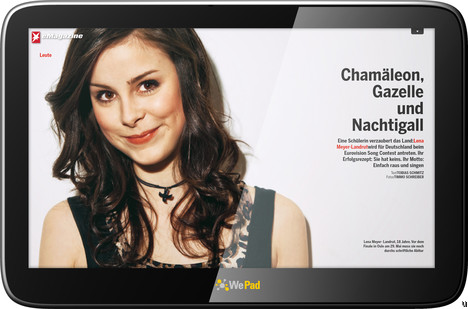
wepad-magazine.jpg
We hear a lot of hubbub these days on so-called Paid Content on the Web. This idea seemed to be more or less dead until rumours of the imminent iPad revived it a few months ago. Publishers now smell a breath of fresh air, betting hugely on Apple’s new geeky device and even on the WePad, at least in Germany.
To make things clear: I’m not opposed to the idea as such. Maybe there is a market for Paid Content on the Web. But this should be decided by the market itself, by consumers who might want to pay or not. It shouldn’t be forced unto them by publishers who once were herolds of the free market or maybe the so-called social market economy, as we like to say in German.
But, and that’s a huge but: The consumer already pays a lot for all kinds of digital content. This has been pointed out a lot of times, but publishers still don’t seem to get it. In the old days, old media were delivered to the consumer who just paid for his newspaper, magazine or cable TV subscription, as he still does today.
With digital media, this model has changed profoundly. Now the consumer pays for the delivery first, and at least in case of mobile media delivery, he still pays a lot of money just for the bandwidth. And just as he has learned with cable TV, the consumer expects most of the media content to be a part of the package he already pays for.
In this new world, publishers save a lot on distribution costs that now are paid for directly by the consumer. If publishers still want the consumer to pay for their content, they have to figure out an added value. It’s clearly not enough to just put the same lame old content behind a paywall and expect the consumer to happily pay a new bill. He already pays for the Web.
That kind of added value is not easy to figure out. Gazillons of start-ups struggled to come up with something the consumer would love to pay for. Most of them failed. Why on earth should traditional publishers be in a superior position? Do they know their consumers better? After watching this space for more than 15 years now (my first login to the Internet was in 1994), I seriously doubt it.

Evan Doll on Designing for the iPad

Since Steve Jobs unveiled the iPad four weeks ago, legions of app developers are pondering their design options. Now there has help for them arrived by Evan Doll who recently posted his slides from a guest lecture for Stanford CS193P (iPhone Application Programming) on February 12, 2010. You can even watch Evan’s presentation through iTunes. [via]

In his talk, he cites the legendary Alan Kay who was shown the iPhone by Steve Jobs shortly before the public launch.

When the Mac first came out, Newsweek asked me what I [thought] of it. I said: Well, it’s the first personal computer worth criticizing. So at the end of the presentation, Steve came up to me and said: Is the iPhone worth criticizing? And I said: Make the screen five inches by eight inches, and you’ll rule the world.

So let’s see if the iPad will rule the world. In the meantime, join us at next10 on May 11 & 12 in Berlin. We’ve just added a whole new conference track called next apps to the conference, dedicated to the exploding mobile app store ecosystem. next apps @ next10 will explore the new market opportunities that are emerging for developers, content creators, service providers, and other market players. Learn more.

Chocolate made via iPhone: Meet TCHO’s Chocolate 2.0.

tcho4_540x426.jpg
Is it possible to be a Game Changer and to be a chocolate maker? Or is it even possible to be a Game Changer by making chocolate?
Usually we know chocolate sold in bars, and in varieties like milk, dark or white. Special flavoured chocolates might contain nuts or fruit. Nothing game changing about that. At San Francisco’s TCHO, the common concept of chocolate was taken and turned on its head. TCHO comes in pots of daily doses, like pills, and it’s all pure black chocolate, with different tastes according to the beans used. Much like coffee.
But there’s more: TCHO is probably the world’s most technology-obsessed chocolate company. At TCHO’s technology meets chocolate in a way never seen before. Or do you know any other chocolate makers who control their chocolate production from anywhere in the world by tapping on their iPhone? Well, I don’t.
The Techie Chocolate was born in 2005 when former Space Shuttle coder Timothy Childs, and founding editor of Wired Louis Rossetto set up TCHO together with chocolate industry veteran Karl Bittong. Their mission: to reverse-engineer chocolate and make the perfect bar.
They started from the very first beginning and revolutionised the traditionally uneven fermentation process. Growers often had to guess how long to leave beans fermenting which led to differing states in taste. By using a modified weather-monitoring system and controlling the temperature inside the piles of beans on their Macs, Childs and Rossetto were able to solve this problem. Thanks to their digital and technical knowledge.
The first chocolate was produced in December 2007 and the Chocolate Scientists were desperate for feedback. But normal market research wouldn’t do. Instead, they issued beta-version chocolate bars wrapped in US Air Force weapons-grade packaging which indicated how much TCHO would come to reject the traditional romanticism of the chocolate industry. The bars, with names such as „Beta C Ghana 0.21″, were put up for sale on TCHO’s website at $5 each and sold out almost instantly. At the end of 2008 the company launched ist first v1.0: „TCHO Chocolatey“.
A special focus was set on the way chocolate was marketed and on differentiationg from the usual. A scientific way of speaking about flavour that would be immediatelly understood by consumers was born. And with it the TCHO „flavour wheel“: Chocolatey, Nutty, Fruity and Citrus.
You see, TCHO is different. And it is innovative. Each chocolate company runs a laboratory to work out new varieties, but only TCHO runs a „TCHO flavour lab“: Mixers, originally designed to grind spices in Indian restaurants, temper cocoa paste and are connected to heaters from Costco. There’s tape from a Space Shuttle programme and a modified turkey oven roasting cocoa beans. And everything is connected to an ethernet node with its own IP address.
Give TCHO a try and see post-digital-revolution guru Louis Rossetto live as a speaker at next10. As co-founder of Wired magazine and with his obsession for building great businesses and creating products he knows the talk. And maybe he’ll bring some chocolate with him…


Was ich mir von Schirrmacher wünsche

anarchie.jpg
Ich bin ein Fan von Frank Schirrmacher. Der Mann versteht es, die richtigen Fragen zu stellen und die wichtigen Themen auf die Agenda zu setzen. Und doch hat er mit seinem jüngsten Bestseller Payback und der anschließenden Debatte im FAZ-Feuilleton knapp am Kern der Sache vorbeigezielt.
Was ist spannender als die Frage, die Schirrmacher umtreibt, ob nämlich der Mensch im digitalen Zeitalter sein Denken und damit sich selbst der Technologie und ihren Imperativen unterwirft? Es ist die Frage nach den Grundwerten, die in die revolutionäre, disruptive Technologie namens Internet selbst eingebaut sind.
Das Internet ist zwar als Forschungsprojekt des US-Militärs entstanden. Doch die in Code gegossenen Wertentscheidungen sind alles andere als militärische. Das Internet ist nicht auf Command and Control gebaut, sondern auf radikale Dezentralität. Für die Militärs war das Internet nicht mehr als eine robuste Infrastruktur, die auch Atomschläge überstehen sollte.
Doch sind in die frühen Baupläne des Internets auch idealistische Vorstellungen vom freien Austausch von Ideen und Informationen eingeflossen, die nichts mit seinen militärischen Wurzeln zu tun haben. Hier hat sich ein starker Widerstand gegen jegliche Reglementierung eingenistet, ein liberal-anarchischer Zug, der im Prinzip die Rechte und Interessen einer kleinen, radikal-liberalen Minderheit stark bevorzugt.
Und an dieser Stelle verbinden sich zwei Interessengruppen, die auf den ersten Blick nichts miteinander zu tun haben: die extremen Individualisten und die Unternehmer, für die das Internet ein Instrument unbeschränkter wirtschaftlicher Tätigkeit im neoliberalistischen Sinne ist. Das ist eine sehr interessante Koalition und ein Thema, das ich mir für Schirrmachers Debatte wünsche.
Hinzu kommt eine transatlantische Differenz in der Gewichtung der freien Meinungsäußerung, des freien Marktes und des freien Unternehmertums. Hätten die Amerikaner ein bürokratisches Monster wie die Europäische Union zugelassen? Hätten die Europäer eine anarchische Technologie wie das Internet erfunden?
Der interaktive Konsument revolutioniert das Marketing. Das Internet revolutioniert unsere ganze Gesellschaft. Auf welchen Werten diese Revolution fußt und in welche Richtung sie unsere Gesellschaft verändert – das wäre spannend zu diskutieren, auch für Schirrmachers Feuilleton.
Foto: dev null