
Okay, der Fairness halber will ich in diesem Beitrag mit allzu harscher Kritik vorsichtig sein, da ich mich selbst seit gut und gerne vier Jahren mit dem so genannten Bürgerjournalismus, Social Media und den (Online-)Strategien von Printmedien auseinandersetze.
Dennoch sei folgender Hinweis gestattet – und er gibt glaube ich den Eindruck im Publikum wieder: Die Moderatorenposition der Diskussion „Der Bürger als Journalist: Geliebt oder geduldet?“ war nicht gerade ideal besetzt, aufgrund nicht weit genug reichender Themenkenntnis. Da waren doch ein paar sehr krude Behauptungen und Fragen dabei, die es unter anderem erschwerten, dass man bei der Debatte zum Thema tatsächlich mal weiterzukommen, als bei den ungezählten Diskussionen zur gleichen Thematik aus den vergangenen Jahren.
Glücklicherweise haben die beiden eigentlichen Protagonisten auf dem Panel, Katharina Borchert, Online-Chefin von DerWesten, dem Onlineportal der WAZ, und Jochen Wegner, Chefredakteur von Focus-Online weitestgehend dagegen halten können und von ihren aktuellen Erfahrungen in ihren jeweiligen Online-Communities berichtet. Deutlich wurde dabei, wie wichtig das Community-Management an beiden Standorten im täglichen redaktionellen Flow inzwischen ist, Man ist im Dialog mit der Zielgruppe – und das quasi in Realtime!
Sowohl Borchert als auch Wegner gaben sich begeistert von ihrer Community, wenngleich sie nicht leugnen, dass es auch die notorischen Dauernörgler und Trolls gibt sowie weitere Umstellungen in den redaktionallen Abläufen (Online First, Newsdesk etc.), die die Macher der Onlineangebote herausfordern. Für Jochen Wegner gehört der Input von Seiten der User inzwischen zum Real-Estate eines modernen journalistischen Internetangebots. Katharina Borchert kann das nur bestätigen. Ihre Erwartungen ob, wie und in welchem Umfang die Leser von DerWesten sich aktiv auf der Website einbringen wurden übertroffen.
In die Begeisterung mischt sich aber auch immer wieder Minifrust, eben weil bei bestimmten Themen die Diskussionen aus dem Ruder laufen. Dennoch: Zuhören was die User sagen, ernst nehmen was die Community bewegt, Moderator und Streitschlichter sein, all das gehört inzwischen zu den Aufgaben der Communitymanager in den Verlagen und das nicht 9 to 5, sondern 24/7, in realtime.
Was das für die Zukunft der Ausbildung bedeutet, wurde im Panel leider nicht behandelt, aber eines ist klar: Es geht nicht darum den „Amateur“, den User, den Leser zum „(Bürger)Journalisten“ zu „erziehen“, sondern zusammen mit den neuen Medienprosumern zu lernen, wie man gemeinsam die Zukunft der Webangebote von Medienhäusern gestaltet.
Mai 2008
Warm welcome & cold drinks
Props to the organizers: Except for the wireless that keeps cutting out – and let’s face it: At which conference doesn’t it? – everything works just fine.

Not only is there enough juice for my laptop, but also for me. (Hint: Power outlets at all the columns!) Even standing here behind Conference Room 1, out in the shade by the lonely LAN cable that allows me to post this, a friendly soul of the catering service brings me an ice-cold drink.

Neat. Thanks to the great service staff!
Just sayin‘.
Jeremy Ruston, British Telecom meets Luis Suarez Rodriguez, IBM: Decaffeinating Tea
First up: Jeremy Ruston of British Telecom.
„Decaffeinating Tea, what’s that supposed to mean?“, you might be asking yourself. (I sure did.) What’s hiding behind the slightly odd title is the question of how individuals are treated, and how they function, in large corporations. Most importantly, what has changed for employees as a person and for the enterprise in what today we call Enterprise 2.0?
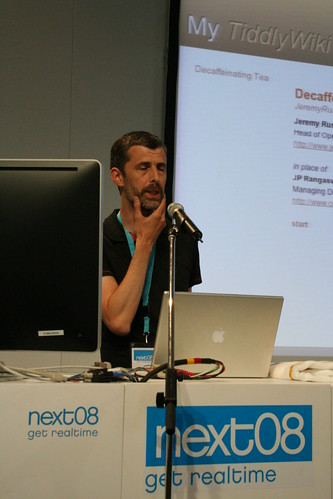
Trust in enterprises has always been a problem: As a cog in the machine, the employee has never been faced with too much trust by their enterprises. In the digital age, things got even worse, just think of the stories you’ve heard about emails where colleagues have cc’d (or even bcc’d) the boss for strategic reasons, i.e. because they didn’t trust their colleagues.
Time, and how people spend it in their jobs, is another issue. Good question raised by Jeremy: If Google’s (or any other company’s for that matter) employees spend 20% of their time researching on stuff they’re personally interested in, what do they work on the other 80% of their working time on?
Teenagers today grow up with an incredibly high media and technology awareness and the relevant skills. Those Digital Natives really know their tech, and their web 2.0 tools. How can enterprises exploit this, or at least not scare those future employees away? After all, if a digital native isn’t able to apply his skills and knowledge in his workplace because corporate policies and infrastructure won’t allow the tools and practices, it’s a lose-lose situation: The employee will be frustrated, the employer can’t get the maximum value for their money.
So how does British Telecom harness the Web 2.0 generation? According to Jeremy Ruston, BT has been pretty early on in the adoption curve. Just to give an example: Use of Facebook was encouraged early on.
Next up: Luis Suarez Rodriguez of IBM.
IBM, if Luis Suarez is indication, is pretty far ahead on the adoption curve. „Collaboration allows us to tap into the power of people“ says one slide which analyzes how we ask out peers and friends for advice in one-on-one situations. How to harness this very mechanism and make it scale to larger groups is one of the big challenges being tackled in our days.
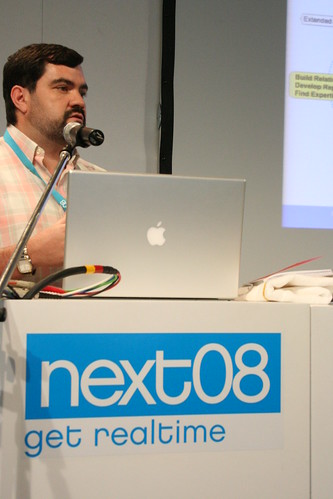
Now it would be great to not only explicitly ask for advice, but to also collaborate more implicitly. Do I really have to write an email to find out which music album to buy as a birthday gift? Probable not – if you manage to tap into smart communities. Technology can enable and foster this kind of exchange, it can help foster relationships between individuals, thus creating a community. It’s people, not data. That’s the very core of online collaboration.
Email is obviously not the way to go. (Challenge: Ask Stowe Boyd about email!) So how can we harness the power of communities? Trust is a key issue: Without trust you cannot anything done. The main challenge, though, is to shift from a controlled, regulated environment to a dynamic environment that fosters spontaneous collaboration – forget org trees! Rodriguez’s message is clear: Email is too inflexible, go for Wiki-style collaboration. (With this presentation, he could’ve easily passed at a Barcamp, too – they’d have loved him.)
Jimmy Maymann, GoViral: Branded activities and social media in the age of Youcracy
The key message in this panel is clear: The age of traditional branding is over. As our connectedness and social life online evolve, branding too becomes more social: Brands increasingly have to rely on their customers‘, friends‘ and social networks‘ recommendations – which is also the core of viral marketing. It it’s not funny, inspiring or otherwise compelling (Maymann calls it emotional, you wouldn’t pass that YouTube video on to your friends, right? But if you do, your friends might watch it just because it was you who sent it. You basically vouch for the content you pass along.
Of course this puts campaigners and communications agencies into a tricky situation: On the one hand, they want to push their clients‘ messages out there; on the other hand, they need the help of those very customers they’re trying to target. Go wrong, and your customers will hold it against you. Social media need a very different approach than traditional media if you want to succeed.
One lessen I learned today? Obviously, if you plan on going viral, funny videos are still the way to go.
Great question from the audience: Social media seem to aim primarily at younger target groups, 40 to 50 years at max. With the massive demographic shift, how can companies reach out to older audiences and engage with them? Maymann doesn’t have the answer. Let’s not hold it against him just yet: The whole field of social media is so young that it’ll need a few years to mature along with those not-so-young folks out there.
Werner Vogels of Amazon: Compete on ideas not resources
„Shut up!“ Werner Vogels of Amazon makes it very clear that all the chatting isn’t really appreciated. The new-found silence is greeted by the audience with applause. Now we can start. Animoto serves as an example to demonstrate Amazon’s Webservices. Animoto, which is basically a slideshow creator on speed (that combines images and sounds to create compelling videos) lives completely in the cloud. Practically all info is pulled in from external services (Flickr etc.) and processed on flexible Amazon server cycles, where the videos are rendered.

This may not sound too special, but it really is, if you think about it: There’s basically no hardware in the whole company, no server infrastructure to be maintained. Everything you need you can rent on the web as you grow: Animoto wa slowly growing until they launched a Facebook app – and went completely viral. Just a few years back, this would have lead to insurmountable scalability issues, these days you can think about scaling when you actually need it. So here we pretty much have a radically different situation for entrepreneurs. (According to the presentation, web companies used to spend 70% of their time on infrastructure work and only 30% on innovation. Amazon claims this has changed. A lot.)
Another issue with regular, central server centers: You might remember the major outage of a big San Francisco-based service provider a few months back. Despite their eight diesel power generators, during a power outage they couldn’t keep up their servers – six of the backup generators failed, according to this speech. A good chunk of the web services based in the Bay Area died that day. This might actually really be a good reason for decentralized hosting.
So far, this speech has been more convincing than some of the presentations in the Elevator Pitch Panel, so it should be interesting to see what the more technologically inclined members in the audience will be asking. Server admins, step forward!
Question from the audience: What about Security? Of course, that’s one of the key aspects for practically any serious startup. Legal jurisdictions are a challenge here – depending on where your data is stored, different laws and regulations apply, different governmental and non-governmental players could get access to your (and your users‘) data.
I’d be curious: Who has experience with Amazon webservices or their Automatic Backup USB Stick? If you do, please share in the comments.